Professioneller Hersteller biomagnetischer Perlen


Wirkmechanismus von Natriumcitrat und Natriumacetat bei der Magnetkügelchensynthese
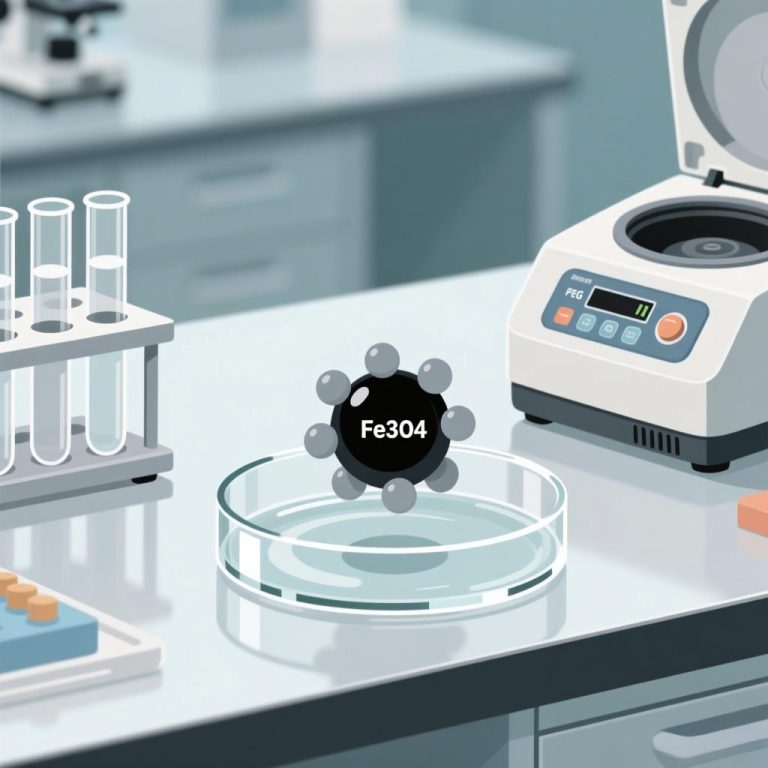
Im Syntheseprozess von Magnetkügelchen (insbesondere Magnetit-Fe₃O₄-Perlen), insbesondere bei der Kopräzipitationsmethode, Natriumcitrat und Natriumacetat spielen unterschiedliche, aber entscheidende Rollen. Ihre Mechanismen drehen sich hauptsächlich um die Kontrolle der Partikelkeimbildung und des Partikelwachstums, Verhinderung von Agglomeration, stabilisierende Dispersion, und Regulierung der Partikelmorphologie und -größe. Nachfolgend finden Sie eine detaillierte Erläuterung der jeweiligen Mechanismen:
ICH. Natriumcitrat (Na₃C₆H₅O₇)
Natriumcitrat fungiert hauptsächlich als Tensid/Stabilisator, Chelatbildner, und Ladungsregler in der Magnetkügelchensynthese.
Oberflächenmodifikation und -stabilisierung (Primäre Rolle):
Adsorption und Koordination: Das Citratanion (C₆H₅O₇³⁻) besitzt drei Carboxylatgruppen (-COO⁻). Diese Gruppen verfügen über eine starke Chelatisierungsfähigkeit und bilden robuste Komplexe mit Fe²⁺/Fe³⁺-Ionen auf der Oberfläche neu gebildeter Fe₃O₄-Nanopartikel, Adsorbiert fest auf der Partikeloberfläche.
Stabilisierung der sterischen Hinderung: Die adsorbierten Citratmoleküle breiten sich nach außen aus, Bildung einer Hydrophilie “Hülse” oder “Schutzschicht.” Wenn sich Teilchen einander nähern, Diese Hülle bildet eine physische Barriere, Vermeidung von direktem Kontakt und Agglomeration (sterischer Stabilisierungsmechanismus).
Elektrostatische Stabilisierung: Die adsorbierten Citratanionen verleihen der Magnetkügelchenoberfläche eine negative Ladung (Erhöhung des negativen Zeta-Potenzials). Die daraus resultierende elektrostatische Abstoßung zwischen gleich geladenen Partikeln verhindert zusätzlich die Agglomeration (Elektrostatischer Stabilisierungsmechanismus). Die kombinierte Wirkung von sterischer Hinderung und elektrostatischer Abstoßung erhöht die kolloidale Stabilität der Perlen in wässriger Lösung erheblich.
Kontrolle der Partikelgröße und Morphologie:
Wachstumsbegrenzung: Durch dichtes Beschichten der Partikeloberfläche, Natriumcitrat begrenzt die Freilegung aktiver Oberflächenstellen, Dadurch wird die Ostwald-Reifung verlangsamt (Auflösung kleiner Partikel und Wachstum größerer Partikel) und Teilchenfusion. Dies trägt dazu bei, kleinere Nanopartikel mit einer gleichmäßigeren Größenverteilung zu erhalten.
Beeinflussung der Keimbildung: Citratanionen können in Lösung lösliche Komplexe mit Fe²⁺/Fe³⁺-Ionen bilden (siehe Chelation unten), Dadurch wird die Konzentration freier Metallionen etwas verringert. Dies kann sich indirekt auf die Keimbildungsrate und die endgültige Anzahl der Partikel auswirken.
Chelatbildung:
Citrat kann sich stabil bilden, wasserlösliche Komplexe mit Fe²⁺- und Fe³⁺-Ionen in Lösung (z.B., [Fe(C₆H₅O₇)]⁻, [Fe(C₆H₅O₇)]⁰, usw.). Dies dient zwei Zwecken:
Pufferung der Metallionenkonzentration: Chelatbildung senkt die momentane Konzentration freier Fe²⁺/Fe³⁺-Ionen, die Fällungsreaktion durchführen (Keimbildung und Wachstum) allmählicher und kontrollierbarer.
Reduzierung der Bildung von Verunreinigungen: Durch Kontrolle der Konzentration freier Ionen, es begünstigt die Bildung eines reineren, besser kristallisierte Fe₃O₄-Phase und reduziert die Entstehung anderer Eisenoxidverunreinigungen (z.B., Goethit, Hematit).
Bereitstellung einer Grundlage für Biokompatibilität (Nachfolgende Bewerbungen):
Citratmodifizierte Perlen haben Oberflächen, die reich an Carboxylgruppen sind (-COOH). Diese Gruppen sind stark hydrophil und biokompatibel. Sie ermöglichen auch problemlos eine kovalente Konjugation mit Biomolekülen (z.B., Antikörper, Proteine, Nukleinsäuren) über Reaktionen wie Amidierung, den Grundstein für biomedizinische Anwendungen legen (z.B., Trennung, Erkennung, gezielte Arzneimittelabgabe).
Zusammenfassung des Mechanismus von Natriumcitrat: Erzielt eine stabile Dispersion durch starke Adsorption/Chelatbildung auf der Partikeloberfläche, sorgt für sterische Hinderung und elektrostatische Abstoßung. Steuert die Partikelgröße, Morphologie, und Kristallinität durch Chelatisierung von Metallionen und Begrenzung des Oberflächenwachstums. Stellt gleichzeitig reaktive Gruppen für die anschließende Biofunktionalisierung bereit.
II. Natriumacetat (CH₃COONa)
Natriumacetat fungiert hauptsächlich als alkalische Quelle, Puffer, und strukturdirigierendes Mittel in der Magnetkügelchensynthese (insbesondere bei hydrothermischen oder solvothermalen Methoden).
Bereitstellung alkalischer Bedingungen (Kernfunktion):
Die Bildung von Fe₃O₄ erfordert alkalische Bedingungen. Natriumacetat hydrolysiert unter Bildung von OH⁻-Ionen:
CH₃COO⁻ + H₂O ⇌ CH₃COOH + OH⁻
This hydrolysis reaction is relatively mild, providing a sustained, controllable alkaline environment for the coprecipitation of Fe²⁺ and Fe³⁺ ions. This is crucial for generating Fe₃O₄ instead of other iron oxides (z.B., α-Fe₂O₃, γ-Fe₂O₃). Insufficient alkalinity tends to produce non-magnetic iron hydroxide colloids.
Buffering Action:
The acetate ion (CH₃COO⁻) and its conjugate acid, acetic acid (CH₃COOH), form a buffer pair. During the reaction (especially under high-temperature hydrothermal/solvothermal conditions), it effectively buffers the pH of the system, preventing drastic local pH fluctuations.
A stable pH environment is essential for controlling the uniformity of the precipitation reaction, obtaining well-crystallized Fe₃O₄ crystals, and ensuring a uniform particle size distribution. Sharp pH changes can lead to explosive nucleation or amorphous precipitate formation, resulting in uneven particle sizes or agglomeration.
Structure-Directing and Morphology Control:
At high concentrations or under specific reaction conditions (z.B., hydrothermal methods), acetate ions can adsorb onto specific crystal facets of Fe₃O₄, altering the relative surface energies of different facets, thereby influencing anisotropic crystal growth.
This adsorption can guide particles to form specific morphologies, such as spheres, Würfel, Oktaeder, or even flower-like structures. Sodium acetate is a commonly used additive for achieving morphology-controlled synthesis.
Promoting Crystallization:
Under the high-temperature and high-pressure environment of hydrothermal/solvothermal reactions, the alkaline buffering environment provided by sodium acetate facilitates the dissolution-recrystallization process of Fe₃O₄ crystals. This promotes the dissolution of small particles and their recrystallization onto larger ones, enhancing the crystallinity of the final product.
Mild Reducing Atmosphere (Secondary Role):
Bei hohen Temperaturen, acetate or acetic acid may decompose, producing small amounts of reducing gases (z.B., carbon monoxide or hydrogen) or weakly reducing intermediates. This helps maintain the stable presence of Fe²⁺ in the reaction system (preventing its excessive oxidation to Fe³⁺), ensuring the formation of Fe₃O₄ close to its stoichiometric ratio (Fe²⁺:Fe³⁺ = 1:2).
Summary of Sodium Acetate’s Mechanism: Creates a stable, suitable alkaline environment for Fe₃O₄ formation and crystallization by hydrolyzing to provide sustained, controllable OH⁻ and buffering pH. Unter bestimmten Bedingungen, it achieves morphology control by adsorbing and regulating facet growth. It may also exhibit weak reducing properties to maintain the Fe²⁺ oxidation state.
Key Differences and Synergistic Effects
Core Functions Differ: The core function of sodium citrate is surface modification and stabilization/dispersion, while sodium acetate’s core function is providing and maintaining the required alkaline reaction environment.
Stage of Action: Sodium citrate primarily acts immediately after particle formation (stabilizing nascent particles) and influences growth. Sodium acetate acts throughout the precipitation reaction (providing OH⁻ and buffering pH), being crucial especially during initial nucleation and crystal growth.
Synergistic Effect: In optimized processes, they are often used together:
Sodium acetate ensures the generation of well-crystallized Fe₃O₄ primary particles at a suitable and stable pH.
Sodium citrate rapidly coats these primary particles, preventing their agglomeration into large precipitates and controlling the size and dispersity of the final nanoparticles.
The chelating action of sodium citrate also complements sodium acetate in maintaining system stability.
Zusammenfassend, in magnetic bead synthesis:
Sodium citrate is an excellent surface stabilizer, dispersant, and size control agent, paving the way for biological applications.
Sodium acetate is a key alkaline source, pH buffer, and morphology control agent, ensuring the formation of high-quality Fe₃O₄ crystals.
Understanding their distinct mechanisms is essential for optimizing the formulation and process parameters (z.B., Konzentration, Temperatur, addition method) in magnetic bead synthesis to obtain magnetic nanoparticles with desired properties (small size, narrow distribution, stabile Dispersion, good crystallinity, controllable morphology).
Anbieter
Shanghai Lingjun Biotechnology Co., Ltd.wurde gegründet in 2016 Das ist ein professioneller Hersteller von biomagnetischen Materialien und Nukleinsäure-Extraktionsreagenzien.
Wir verfügen über umfangreiche Erfahrung in der Extraktion und Reinigung von Nukleinsäuren, Proteinreinigung, Zelltrennung, Chemilumineszenz, und anderen technischen Bereichen.
Unsere Produkte werden in vielen Bereichen weit verbreitet eingesetzt, wie zum Beispiel medizinische Tests, Gentests, universitäre Forschung, genetische Zucht, und so weiter. Wir liefern nicht nur Produkte, sondern können auch OEM übernehmen, ODM, und andere Bedürfnisse. Wenn Sie einen entsprechenden Bedarf haben, Nehmen Sie gerne Kontakt zu uns auf .