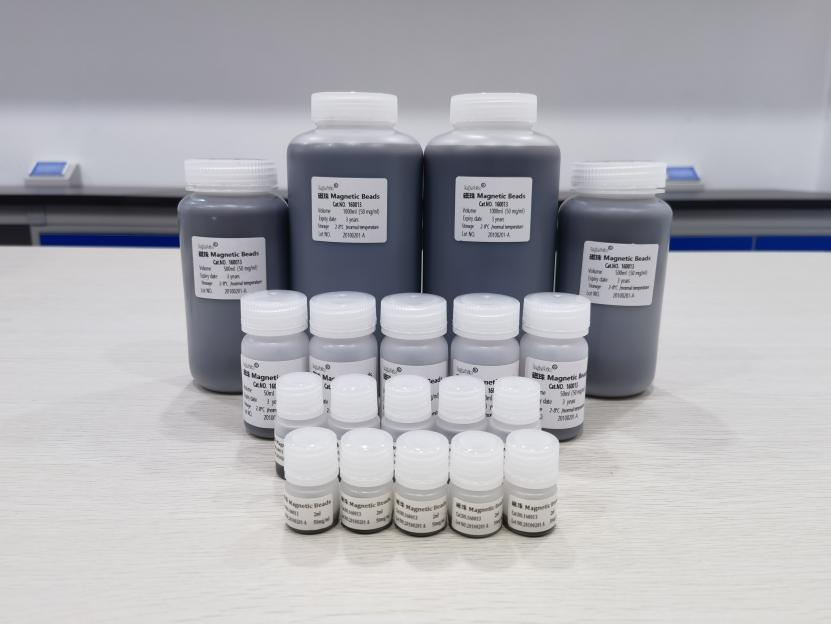

生体磁気ビーズの専門メーカー

磁気ビーズの価格: 3 収益戦略 & 市場の成長
導入
In the increasingly competitive market environment of the 磁気ビーズ industry, corporate pricing is no longer a simple calculation of cost plus profit, but a comprehensive decision-making process integrating market positioning, product value, customer needs, and competitive landscape.
This article will deeply analyze the pricing environment faced by magnetic beads companies and propose three efficient pricing strategies, providing a practical framework for industry players to enhance profitability and market position.
1. Magnetic Beads Industry Characteristics & Pricing Challenges
Magnetic beads products, categorized mainly into pre-activated magnetic beads, immunomagnetic beads, and inductive magnetic beads based on their application fields, are widely used in in vitro diagnostics, イムノアッセイ, 細胞分離, and other areas.
This industry has several distinct characteristics: Highly customized products—most magnetic bead products are non-standard and require specialized design and production based on client needs; High technological barriers—requiring specialized production processes and technical support.
Simultaneously, raw material costs constitute a significant portion, and price fluctuations of raw materials like rare earth elements can significantly impact production costs. Furthermore, market demand is highly diversified, with vastly different requirements for product performance, precision, and specifications across various application fields.
Magnetic beads companies face multiple pricing challenges: On one hand, market competition from international brands like Merck and Tofflon, as well as numerous domestic manufacturers, intensifies price pressure.
On the other hand, exchange rate fluctuations significantly impact export-oriented companies. さらに, the transmission of raw material price volatility is lagged, often causing sales price adjustments to trail behind raw material price changes by 3-6 months.
さらに, customers’ bargaining power has increased, particularly in fields like new energy vehicles, where strong customer negotiation ability puts significant cost-reduction pressure on downstream companies in the industrial chain.

2. Three Efficient Pricing Strategies & Key Implementation Points
2.1 Cost-Plus Pricing Method
Cost-plus pricing is the most fundamental and widely used pricing method in the magnetic beads industry, especially suitable for customized, non-standard products.
The core of this method lies in comprehensively accounting for costs, including direct materials, labor, manufacturing overhead, 等, while comprehensively considering the product’s processing complexity, performance requirements, and qualification rate. The product quotation is determined based on a reasonable profit margin added to the estimated cost.
The key to implementation is that companies must establish a detailed cost accounting system to accurately track all costs. 同時に, they should regularly review and adjust profit margins to align with market levels and corporate strategy.
It is important to note that companies must grasp the timing of price adjustments, minimizing the time lag between rising raw material costs and sales price adjustments.
2.2 Value-Based Pricing Method
Value-based pricing sets prices according to the actual value the product creates for the customer, better reflecting the differentiated advantages of high-end products.
This strategy requires a deep understanding of customer needs, distinguishing customer groups by application field, such as automotive, medical, エレクトロニクス, 等, as different fields have varying performance requirements for magnetic beads products.
It also involves quantifying product benefits. For instance, certain magnetic beads products can help customers improve production efficiency, enhance detection accuracy, or reduce defect rates. This value can be incorporated into pricing considerations.
The key to implementing value-based pricing is strengthening product differentiation, highlighting the unique advantages of one’s own products in terms of performance, precision, or in specific application scenarios. Furthermore, sharing the value creation with customers by demonstrating through data how the product reduces costs and increases efficiency for them, thereby gaining customer acceptance of the higher price.
2.3 Competition-Based Pricing Method
Competition-based pricing adjusts price levels according to the market competition landscape. It is suitable for magnetic bead product areas with a high degree of standardization or intense competition.
This method requires companies to regularly analyze competitors’ pricing strategies and understand the price ranges and promotional tactics of main competitors. It also involves assessing the market positioning of their own products—whether they are market leaders or followers—and setting prices accordingly.
When implementing competition-based pricing, maintaining price flexibility and adjusting prices promptly based on market feedback is crucial. さらに, it is essential to avoid vicious price wars, maintaining reasonable profit margins through value-added services, technical support, and differentiation.
3. Optimization of Pricing Strategies & Implementation Safeguards
To ensure the effective execution of pricing strategies, magnetic beads companies need to establish safeguard mechanisms in the following areas:
- Establish a dynamic price adjustment mechanism. Regularly evaluate the alignment of product prices with the market. Set triggers for price adjustments, such as initiating a price review procedure when raw material price fluctuations exceed a certain percentage.
- Simultaneously, optimize product portfolio pricing, distinguishing between high-margin products and fighter products to maximize the overall profit of the product portfolio.
- Strengthen supply chain cost management. Establish long-term cooperative relationships with upstream suppliers to stabilize raw material supply prices. Improve production automation levels to reduce the proportion of labor costs.
- 同時に, optimize production processes to increase product qualification rates and material utilization.
- Enhance customer segmentation and differentiated services. Identify the price sensitivity of different customer segments and provide exclusive technical support and services for high-value customers.
- Furthermore, establish long-term strategic partnerships, signing long-term agreements with key customers to balance price and supply stability.
まとめ
In the magnetic beads industry, there is no one-size-fits-all pricing strategy. Successful companies are often those that can flexibly combine and apply various pricing methods based on their own product characteristics, market positioning, and customer needs, and continuously optimize and adjust in a dynamically changing market environment.
The most effective pricing strategy is one that not only covers costs and achieves reasonable profits but is also recognized by customers and fosters long-term cooperative relationships. This is the key to the sustainable development of magnetic beads companies in the fierce market competition.
サプライヤー
上海霊軍生物技術有限公司, 株式会社に設立されました 2016 生体磁性材料と核酸抽出試薬の専門メーカーです.
核酸抽出・精製の経験が豊富です。, タンパク質の精製, 細胞分離, 化学発光, その他の技術分野.
当社の製品はさまざまな分野で広く使用されています, 医療検査など, 遺伝子検査, 大学の研究, 遺伝子育種, 等々. 製品のご提供だけでなくOEMも承ります, ODM, その他のニーズ. 関連するニーズがある場合, お気軽にお問い合わせください .