Professional Manufacturer of Biomagnetic Beads


Why PCR identification require high-quality DNA templates?
The magnetic bead method for obtaining high-quality DNA templates from plant tissues is crucial for subsequent PCR identification and can be considered the cornerstone of successful molecular identification. Its importance is primarily reflected in the following aspects:
1.Effective removal of PCR inhibitors.
Plant tissues are rich in polysaccharides, polyphenols, pigments, tannic acid, and secondary metabolites, which are known to be potent PCR inhibitors. The magnetic bead method efficiently removes these impurities through the following mechanisms: selective binding: under specific buffer conditions, magnetic beads specifically bind to DNA, while inhibitors remain in the supernatant and are discarded.
Efficient washing: Through multiple washes, the inhibitor residues adsorbed on the magnetic beads can be completely removed.
Significance: Incomplete removal of the inhibitor will severely suppress the activity of Taq DNA polymerase, leading to PCR failure (false negative), low product yield, weak or nonspecific bands, and completely unreliable results.
2.Obtaining high-purity and intact DNA High-purity:
The A260/A280 ratio of DNA obtained by the magnetic bead method is typically close to 1.8, and the A260/A230 ratio is greater than 2.0, indicating minimal residues of proteins, salt ions, and organic solvents. High-purity DNA is a prerequisite for the efficient conduct of enzymatic reactions (e.g., PCR).
Moderate integrity: For PCR identification (typically amplification fragments <3 kb), the DNA fragment length (typically> 20 kb) provided by the magnetic bead method fully meets the requirements, while avoiding batch variations caused by mechanical shearing of long DNA chains.
3.Enhanced stability and reproducibility of PCR reactions:
The magnetic bead method exhibits high automation, minimal human operational errors, and consistent DNA quality across different batches.
Quantitative accuracy: High-purity DNA can be precisely quantified using spectrophotometers or fluorometers. This enables the addition of accurate and consistent DNA template quantities during PCR reaction setup, which is crucial for obtaining reproducible and reliable PCR results. If the DNA contains impurities, its absorbance values will be inaccurate, leading to improper template addition.
4.Suitable for high-throughput and automated
For identification tasks requiring processing large sample volumes (e.g., germplasm screening, transgenic detection), the magnetic bead method can efficiently achieve high-throughput extraction in 96-well plates and is compatible with automated liquid handling workstations.
The importance is reflected in that the efficiency and standardization level of the appraisal work are greatly improved on the premise of ensuring high quality.
5.Enhancing the sensitivity and specificity of PCR High sensitivity:
High-quality DNA templates allow for higher dilution factors, thereby reducing the concentration of residual inhibitors and enabling the detection of trace amounts of target DNA in some cases.
High specificity: The pure template and precise concentration facilitate the optimization of PCR conditions, enabling primers to specifically bind to the template, thereby reducing non-specific amplification and primer dimer formation, resulting in clear and single amplification bands.
6.Comparison of advantages with traditional methods:
Compared to conventional CTAB and SDS methods, the magnetic bead method demonstrates significant advantages in terms of speed, safety (avoiding harmful organic reagents), operational simplicity, automation compatibility, and inhibitor removal efficiency. It is particularly suitable for challenging plant samples with high polysaccharide and polyphenol content (e.g., tea leaves, pine needles, strawberries, tubers, etc.).
Summary: The core importance of obtaining high-quality plant genomic DNA through the magnetic bead method for PCR identification lies in the following chain: high-quality DNA (magnetic bead method) → high purity/inhibitor-free → accurate template quantification + optimal enzyme activity environment → efficient, stable, and reproducible PCR reactions → accurate, reliable, and credible identification results.
7.Experimental Cases
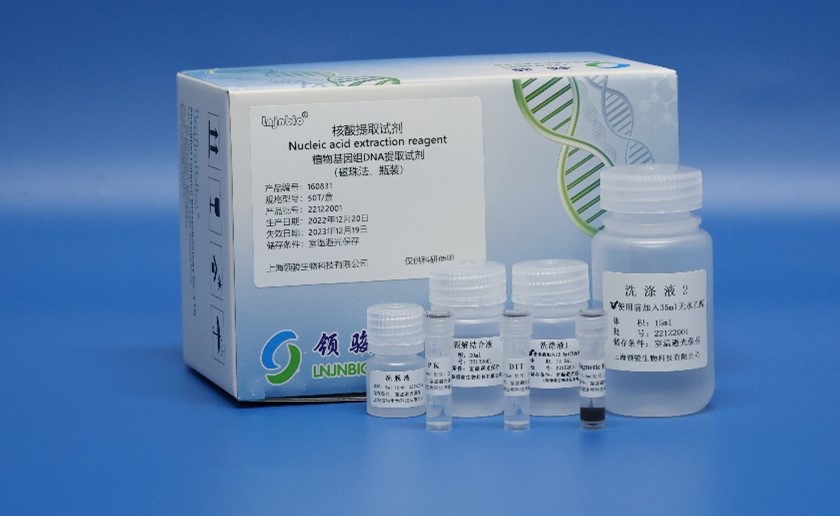
Genomic DNA extraction was performed using our company’s plant tissue genomic DNA extraction reagent (magnetic bead method) on multiple fresh young tissue samples. The results are as follows:
| No. | Sample | Intake | A260/A280 | A260/A230 | Conc. (ng/μL) |
| 1 | Bok Choy | 5mg | 1.956 | 2.035 | 359.9 |
| 2 | Onion | 1.922 | 2.108 | 305.9 | |
| 3 | Spinach | 1.95 | 1.894 | 495.85 | |
| 4 | Shanghai Green | 1.979 | 2.069 | 658.7 | |
| 5 | Brassica rapa | 1.924 | 1.973 | 318.8 | |
| 6 | Caraway | 1.975 | 2.152 | 756.3 | |
| 7 | Lettuce | 1.896 | 1.84 | 122.55 |
The electrophoresis diagram is as follows:
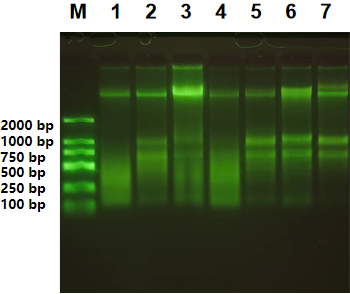
Therefore, prior to conducting plant molecular identification (e.g., genotyping, species identification, transgenic detection, pathogen detection), optimizing and utilizing reliable methods such as magnetic bead technology to obtain high-quality genomic DNA represents a critical investment that yields twice the result with half the effort, directly determining the success or failure of the entire identification project. In practice, for samples with repeated PCR failures, the quality of the DNA template should first be re-evaluated and purified.
Supplier
Shanghai Lingjun Biotechnology Co., Ltd. was established in 2016 which is a professional manufacturer of biomagnetic materials and nucleic acid extraction reagents.
We have rich experience in nucleic acid extraction and purification, protein purification, cell separation, chemiluminescence, and other technical fields.
Our products are widely used in many fields, such as medical testing, genetic testing, university research, genetic breeding, and so on. We not only provide products but also can undertake OEM, ODM, and other needs. If you have a related need, please feel free to contact us .