Professional Manufacturer of Biomagnetic Beads

PEG/Salt Buffer Optimization | Maximize Magnetic Bead Stability & Assay Consistency
Decoding PEG/Salt Buffer Optimization for Reliable Magnetic Bead Performance
In NGS library preparation, fragment screening, and targeted capture experiments, silica-based magnetic beads have become an indispensable core tool. However, many researchers have encountered this dilemma: newly opened beads show excellent recovery rates, but after storage, their performance quietly declines—recovery becomes inconsistent, nonspecific adsorption increases, and the integrity of target fragments is compromised. Often, the root cause is not the beads themselves, but the “invisible inactivation” of the storage buffer. As deep explorers in magnetic bead technology, we understand that 90% of a bead’s long-term stability and performance reproducibility depends on its “living environment”—the design of the storage buffer. Today, starting from first principles, we will reveal how to scientifically adjust the PEG/salt buffer to construct a stable system that allows silica-based magnetic beads to maintain peak performance over the long term.
The Root of the Problem: Why Can’t Ordinary PEG/Salt Buffers Support Long-Term Storage?
While the traditional PEG/NaCl system enables short-term binding, it has three major flaws as a storage solution:
Salting-Out and Aggregation: High concentrations of salt ions (e.g., NaCl, Mg²⁺) can cause irreversible salting-out aggregation of beads during storage.
Hydrolysis and pH Drift: Absorption of CO₂ or water evaporation can shift the pH, disrupting the surface charge balance of the silica matrix.
Lack of Protective Barrier: The active sites on the bead surface gradually deactivate or adsorb impurities during prolonged static storage.
The Solution: Building an Integrated Four-Part “Intelligent Stabilization” Buffer System
Validated through hundreds of experiments, we propose the following optimized buffer formulation and preparation logic.
Core Formulation (for 100 mL):
PEG 8000: 6.5% (w/v)
Concentration is precisely adjusted based on target fragment size: 6.5-7.5% for 100-300 bp, 7.5-8.5% for 300-1000 bp.
Salt Ion System: 1.5 M NaCl + 10 mM MgCl₂
Mg²⁺ significantly enhances recovery specificity for long fragments >500 bp.
pH Stabilizer: 10 mM Tris-HCl, pH 5.5
Key Innovation: Lowering the pH from the conventional 7.5-8.0 to 5.5-6.0 greatly slows the hydrolysis of siloxane bonds (Si-O-Si), enhancing the long-term stability of the magnetic core coating.
Steric Protectant: 0.1% (w/v) Protease-Treated BSA
Forms a monomolecular protective layer, preventing direct bead-to-bead contact and aggregation.
Chelating Antioxidant: 5 mM EDTA + 0.01% (w/v) Sodium Ascorbate
Chelates heavy metal ions and prevents oxidative free radical damage to the bead surface chemistry.
Wetting & Dispersing Agent: 0.01% (v/v) Tween-20
Ensures beads remain in a homogeneous suspension, preventing sedimentation and caking.
Deep Dive into the Mechanism: The Precise Mission of Each Component
Precise Control of PEG 8000 Concentration
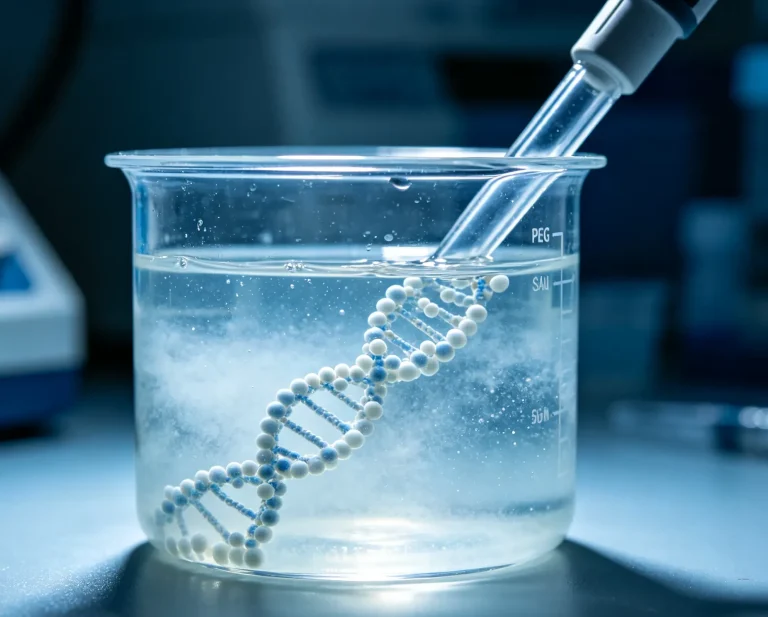
PEG promotes DNA contact with the bead surface via the “volume exclusion effect.” Low concentration reduces recovery of small fragments, while high concentration easily leads to nonspecific adsorption. The 6.5-8.5% range is the “golden window” validated by turbidity titration and recovery curves, achieving both high recovery and high fragment selectivity.
The Stability Revolution at pH 5.5
In a weakly acidic environment, the silanol groups (Si-OH) on the silica surface are more protonated. This not only reduces their self-condensation but also inhibits alkaline hydrolysis of nucleic acids. Experimental data shows that the integrity of recovered fragments (DV200 value) for beads stored at pH 5.5 for 6 months is higher than for those stored at pH 8.0.
Synergistic Effect of Composite Salt Ions
NaCl provides the main driving force, while the addition of MgCl₂, through divalent cation bridging, enhances capture efficiency for long fragments without increasing background adsorption. Strictly controlling the ionic strength to the equivalent of 1.2-1.5 M NaCl is key to balancing binding force and storage stability.
Construction of the Protective Network
BSA and Tween-20 form a physical steric barrier, while EDTA and sodium ascorbate build a chemical protection network. These four components work in synergy, “isolating oxygen, isolating metals, and isolating each other” at the microscopic level, achieving true hibernation-like preservation for the beads.
Operational Guide: A Ready-to-Use Solution
To ensure ultimate reproducibility in your experimental results, we strongly recommend:
Aliquot Storage: Resuspend the beads in the optimized buffer described above and aliquot them into single-use volumes.
Pre-use Activation: Simply wash twice with the original binding buffer (without protectants) to restore optimal binding activity.
Quality Control: Before using each batch of beads, perform a small-scale test with a 10 ng standard DNA fragment to determine if the recovery rate meets your qualification criteria.
Product Introduction
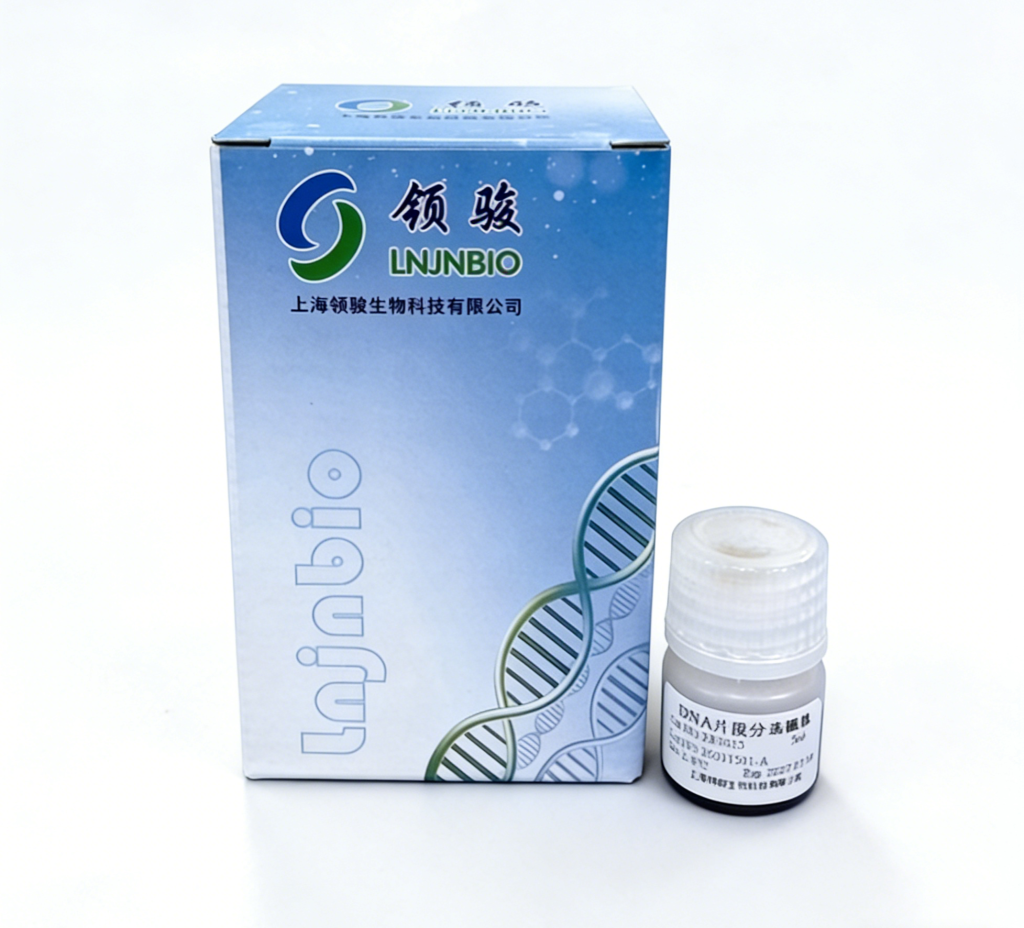
Leveraging mature bead design and manufacturing processes, Shanghai Lingjun Biotechnology Co., Ltd. has developed its high-performance FR0015 Series Silica Magnetic Beads. With an average particle size of 400nm-500nm, strong magnetic properties, excellent monodispersity, and a half-sedimentation time exceeding 1 hour, this product line is primarily suited for:
Serum/Plasma cell-free DNA/RNA fragment extraction
DNA fragment sorting/selection
Applications requiring excellent bead suspension stability and co-extraction of DNA/RNA fragments across a broad size range.
Conclusion
The Science of Stability is the Cornerstone of Reproducibility
Magnetic bead selection is not just a technique, it’s a precise systems engineering project. A deeply optimized buffer is like a “stellar hibernation pod” crafted for the beads, allowing time to stand still during storage and their full potential to shine during use. Choosing focus means choosing ultimate stability in every round of experiments. Let’s start with the fundamental science of the buffer and redefine the reliable boundaries of magnetic bead performance.
Supplier
Shanghai Lingjun Biotechnology Co., Ltd. was established in 2016 which is a professional manufacturer of biomagnetic materials and nucleic acid extraction reagents.
We have rich experience in nucleic acid extraction and purification, protein purification, cell separation, chemiluminescence, and other technical fields.
Our products are widely used in many fields, such as medical testing, genetic testing, university research, genetic breeding, and so on. We not only provide products but also can undertake OEM, ODM, and other needs. If you have a related need, please feel free to contact us .