生体磁気ビーズの専門メーカー


優しい取り扱い: DNA 断片選択の交渉不可能なベースライン
序文
In the workflow of silica-based magnetic bead DNA fragment selection, オペレータは一見矛盾した要件に直面しています: 効率的な結合を維持しながらビーズと DNA を完全に混合する必要があります。 “extreme gentleness” throughout to avoid any vigorous physical agitation. Many experimenters underestimate the importance of the latter, considering it merely routine advice to prevent spills. しかし, scientific data clearly shows that physical shearing is a silent ‘killer’ leading to degraded selection product quality, irreproducible results, and even experimental failure. This article will delve into the underlying molecular mechanisms and provide a rigorous set of anti-shearing operational standards.
1. Core Scientific Principle: DNA Molecules are Fragile Linear Polymers
DNA is not a rigid rod but exists in solution as a flexible, long-chain polymer in a random coil conformation. Its resistance to fluid shear forces, described in physical terms, depends on its persistence length (約 50 nm) and its contour length (total length).
Sources of Shear Force: Operations such as vigorous vortexing, rapid pipetting with forceful aspiration and dispensing, and repeated pipetting through fine pipette tips (especially with pipettors set to high speeds) generate powerful laminar or turbulent shear forces within the liquid.
Mechanism of Shearing: When a fluid shear gradient is applied to a relaxed, long DNA chain, different segments of the chain experience pulls in different directions and at different speeds. When this tensile force exceeds the mechanical strength of the DNA chain (particularly the tolerance limit of the phosphodiester bonds), the chain undergoes non-specific breakage at its mechanically weakest points.
Length-Dependent Fragility: The longer the DNA chain, the larger its hydrodynamic radius and the greater the tension differential it experiences in a shear flow field, making it more susceptible to shearing. A long fragment >10 kb can be sheared into several random 1-3 kbフラグメント, and even a 300 bp target fragment can be cut into useless short pieces.
2. The Catastrophic Impact of Shearing on Fragment Selection Results
Introducing non-specific shearing into an experiment designed to select DNA by length is tantamount to contaminating the sample at its source. The effects are systemic and destructive:
2.1 Target Fragment “Disappearance” and Plummeting Recovery
The specific length fragment you wish to select (例えば, 450 血圧) may be randomly cleaved during handling, reducing the number of molecules in that size range. This directly manifests as a recovery rate far below expectations.
2.2 Degradation of Product Purity and Resolution
The random short fragments generated by shearing become new impurities. They may: あ) Compete with target fragments for binding sites during selection, interfering with normal selection kinetics; B) Be mistakenly recovered because their length may fall within the selection window, leading to a broadened length distribution of the final product, the appearance of spurious peaks, an elevated baseline on the electropherogram, and severely degraded resolution.
2.3 Introduction of an Untraceable Variable, Destroying Reproducibility
The degree of shearing is highly dependent on the vigor of the specific handling, a variable that is difficult to quantify and varies from person to person and time to time. It leads to inexplicable differences in results between different operators, or even between different batches by the same operator, utterly destroying experimental reproducibility and rendering subsequent optimization and data analysis meaningless.
3. High-Risk Operations to Avoid and Standard Gentle Handling Protocols
Based on the above principles, we establish the following mandatory experimental operation guidelines:
3.1 Prohibited Items (High-Risk Operations):
Vigorous Vortexing: Absolutely prohibit vortex mixing of tubes containing DNA or DNA-bead complexes.
High-Speed/Vigorous Shaking: Using excessively high rotation speeds (>1000 rpm) on a shaker/mixer.
Forceful Repeated Pipetting: 急速な, forceful repeated aspiration and dispensing with a pipette tip against the tube bottom or into liquid bubbles in an attempt to mix or resuspend.
Using Standard Fine Tips for Handling Large Fragment Samples: Using uncut, fine pipette tips for pipetting long-fragment DNA or bead complexes.
3.2 Standard Operating Protocol (Gentle Handling SOP):
Mixing/Resuspension Operations:
Preferred Method: Gentle inversion mixing. Securely cap the tube and perform slow, repeated 180-degree inversions by hand or using a device.
Alternative Method: Use wide-bore (cut) tips for slow, gentle pipette mixing. Cut off the narrow end of the pipette tip with sterile scissors to create a large aperture, then slowly aspirate and dispense the liquid, avoiding bubble formation throughout.
Pipetting Operations:
Use wide-bore (cut) or low-retention wide-bore tips for all steps.
Adjust Pipettor Speed: Set modern electronic pipettors to the slowest speed setting for both aspiration and dispensing.
Slow Addition Along the Wall: When adding reagents, allow the liquid stream to flow slowly down the tube wall, avoiding direct impact onto the liquid surface or the pelleted bead mass.
3.3 Bead-Specific Handling Notes:
Resuspending Bead Pellets: After removing the tube from the magnetic rack, if resuspension of beads for washing is needed, add buffer and resuspend via gentle inversion or the gentle pipette mixing described above. Vortexing is strictly prohibited.
Transferring Supernatant: After separation on the magnetic rack, when aspirating the supernatant, keep the pipette tip away from the gathered bead pellet to avoid touching or disturbing the beads.
4. Advanced Validation: How to Confirm If Your Handling is Gentle Enough?
If you suspect past results were affected by shearing, you can perform the following validation experiments:
4.1 Control Experiment:
Take the same long-fragment DNA sample (例えば, unfragmented genomic DNA ) and split it into two aliquots. Subject one aliquot to standard “gentle handling” procedures. Subject the other to simulated improper handling (例えば, vortex several times). Then analyze both simultaneously by Pulsed-Field Gel Electrophoresis or a high-resolution long-fragment analyzer . Visible smearing or a decrease in main band intensity is evidence of shearing.
4.2 Monitoring Selection Product Profiles
In routine selection experiments, if the final product’s electropherogram consistently shows unexplained “humps” or baseline elevation in the short-fragment region (例えば, <100 血圧), operational shearing is the primary suspect after ruling out enzyme and reagent contamination.
4.3 結論: Elevating “Gentleness” from a Suggestion to a Mandatory Process Standard
In DNA fragment selection and indeed all operations involving intact nucleic acid molecules, “gentleness” is not an optional precaution but a core process parameter that must be designed, standardized, and strictly adhered to. It safeguards not only the success of a single experiment but also the foundation of data reliability and reproducibility for the entire research project.
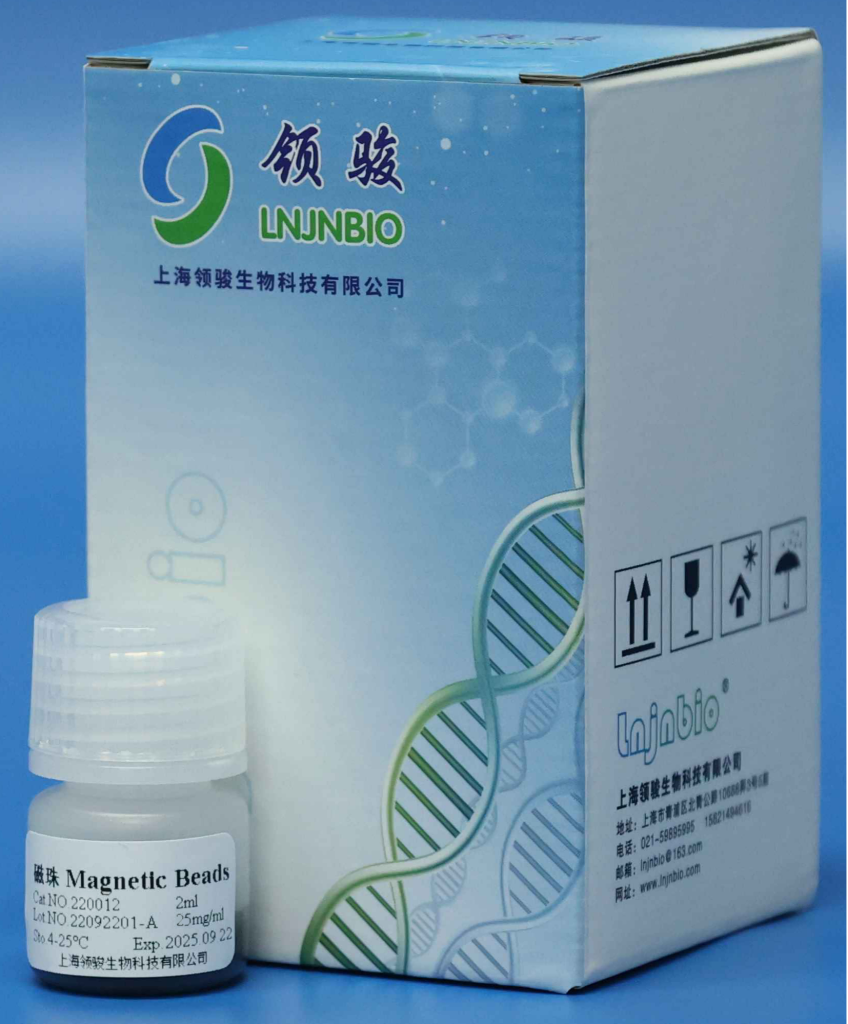
の 凌君略歴 220012 Series high-performance silica-based magnetic beads, with their excellent suspension properties and uniform monodispersity, achieve rapid and homogeneous dispersion under gentle inversion, significantly reducing the risk of having to resort to vigorous agitation to achieve adequate mixing. By choosing our product and combining it with the rigorous operational protocols described herein, you will be able to maximize the protection of your precious sample integrity, ensuring that fragment selection technology delivers true, clear, and reproducible molecular information for your research.
サプライヤー
上海霊軍生物技術有限公司, 株式会社に設立されました 2016 生体磁性材料と核酸抽出試薬の専門メーカーです.
核酸抽出・精製の経験が豊富です。, タンパク質の精製, 細胞分離, 化学発光, その他の技術分野.
当社の製品はさまざまな分野で広く使用されています, 医療検査など, 遺伝子検査, 大学の研究, 遺伝子育種, 等々. 製品のご提供だけでなくOEMも承ります, ODM, その他のニーズ. 関連するニーズがある場合, お気軽にお問い合わせください .