생체자기비즈 전문제조업체


폴리스티렌 마이크로스피어’ 질문과 답변
1. 폴리스티렌 미소구체란 무엇입니까??
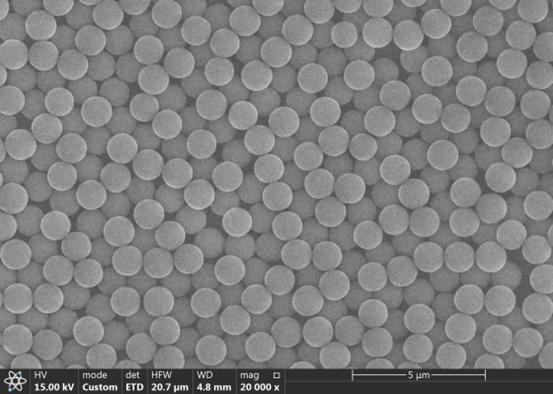
Polystyrene microspheres are spherical particles of highly uniform size made from polystyrene polymer. 직경은 일반적으로 나노에서 마이크론 범위입니다. (예를 들어. 50nm – 100μm). They are standard particles and functional materials widely used in laboratory and industrial production due to their highly uniform particle size, good stability and easy surface modification.
2. What are the main applications of polystyrene microspheres?
Their applications are very wide-ranging and mainly include:
- Standards and calibration: As standards for particle sizer, flow cytometer, electron microscope, 등. for calibration and accuracy verification.
- Biomedical research: After surface modification with carboxyl and amino groups, it can covalently bind antibodies, 단백질, nucleic acids and other biomolecules, which can be used for immunoassay, 셀 정렬, biosensing and so on.
- Materials Science: As templates for the preparation of photonic crystals and porous materials, or as additives to improve the properties of composite materials.
- Modelling and simulation: used as model particles in colloid science, fluid mechanics research, used to simulate the motion and behaviour of the particle system.
3. Why do polystyrene microspheres usually require surface modification? What are the common modification groups?
The surface of pristine polystyrene microspheres is hydrophobic and lacks active reactive sites, limiting their ability to bind to biomolecules or other materials. Surface modification is possible:
- Introduce reactive functional groups to enable covalent coupling with target molecules.
- Improve hydrophilicity and reduce non-specific adsorption.
- Endow microspheres with specific electrical properties (예를 들어, negatively charged) or functionality.
Common modifying groups include:
- Carboxylic (-쿠오): most commonly used and can be coupled to amino-modified biomolecules (예를 들어. 항체) by the carbodiimide (EDC) 방법.
- Amino group (-NH2): positively charged and can bind to negatively charged molecules or surfaces.
- Sulfonic acid group: Provides a stronger negative surface charge and enhances colloidal stability.
- Streptavidin/Affinity: For efficient and specific capture of biotin-labelled molecules.
4. How to choose the size of polystyrene microspheres?
The choice of size depends entirely on the application:
- For instrument calibration: A size that is known to be highly uniform within the measurement range of the instrument.
- For flow cytometry: Micron-sized microspheres (예를 들어, 1-10 μm) of similar size to the cells are usually chosen for setting thresholds, calibrating light scattering channels, and fluorescence intensity.
- For phagocytosis or internalisation studies: microspheres of 0.5-3μm are often chosen.
- For preparation of photonic crystals: very well dispersed microspheres (200-300nm common) are required, which self-assemble to produce structural colours.
- For in vivo imaging or drug delivery: nanoscale microspheres below 100 nm are often chosen to circulate in blood vessels and penetrate tissues.
5. How is fluorescence produced in fluorescent polystyrene microspheres?
The fluorescence in fluorescent polystyrene microspheres does not come from the polystyrene itself, but from the introduction of fluorescent dyes (예를 들어. FITC, rhodamine, fluorescein, 등.) into the internal polymer matrix of the microspheres, either by physical embedding or chemical bonding. This approach results in a very stable fluorescent signal that is not easily quenched and achieves a very high fluorescence intensity, making it ideal for use as a marker and fluorescent standard for quantitative assays.
공급자
상하이 링쥔 생명공학 유한회사, 주식회사에 설립되었습니다 2016 생체자성재료 및 핵산추출시약 전문제조업체입니다..
핵산 추출 및 정제 분야에서 풍부한 경험을 보유하고 있습니다., 단백질 정제, 세포 분리, 화학발광, 및 기타 기술 분야.
우리의 제품은 많은 분야에서 널리 사용됩니다., 의료 테스트와 같은, 유전자 검사, 대학 연구, 유전자 육종, 등. 우리는 제품을 제공할 뿐만 아니라 OEM도 수행할 수 있습니다., ODM, 그리고 다른 필요. 관련된 필요사항이 있는 경우, 저희에게 연락하게 자유롭게 느끼십시오 .