Fabricant professionnel de perles biomagnétiques


Microsphères de polystyrène’ Questions et réponses
1. Que sont les microsphères de polystyrène?
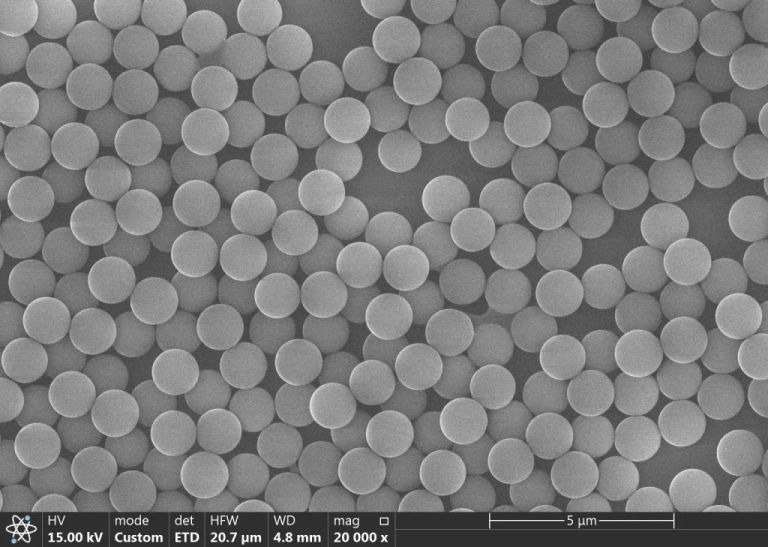
Microsphères de polystyrène sont des particules sphériques de taille très uniforme fabriquées à partir de polymère de polystyrène. Leurs diamètres sont généralement compris entre le nano et le micron. (par exemple. 50nm – 100µm). Ce sont des particules standards et des matériaux fonctionnels largement utilisés en laboratoire et dans la production industrielle en raison de leur granulométrie très uniforme., bonne stabilité et modification facile de la surface.
2. Quelles sont les principales applications des microsphères de polystyrène?
Leurs applications sont très variées et comprennent principalement:
- Étalons et étalonnage: Comme normes pour le granulomètre, cytomètre en flux, microscope électronique, etc.. pour l'étalonnage et la vérification de la précision.
- Recherche biomédicale: Après modification de surface avec des groupes carboxyle et amino, il peut lier de manière covalente les anticorps, protéines, acides nucléiques et autres biomolécules, qui peut être utilisé pour le dosage immunologique, tri cellulaire, biodétection et ainsi de suite.
- Science des matériaux: Comme modèles pour la préparation de cristaux photoniques et de matériaux poreux, ou comme additifs pour améliorer les propriétés des matériaux composites.
- Modélisation et simulation: utilisé comme particules modèles dans la science des colloïdes, recherche en mécanique des fluides, utilisé pour simuler le mouvement et le comportement du système de particules.
3. Pourquoi les microsphères de polystyrène nécessitent-elles généralement une modification de surface? Quels sont les groupes de modifications courants?
La surface des microsphères de polystyrène vierges est hydrophobe et manque de sites réactifs actifs, limiter leur capacité à se lier à des biomolécules ou à d’autres matériaux. Une modification de surface est possible:
- Introduire des groupes fonctionnels réactifs pour permettre un couplage covalent avec des molécules cibles.
- Améliorer l’hydrophilie et réduire l’adsorption non spécifique.
- Doter les microsphères de propriétés électriques spécifiques (par ex., chargé négativement) ou fonctionnalité.
Les groupes de modification courants incluent:
- Carboxylique (-COOH): le plus couramment utilisé et peut être couplé à des biomolécules amino-modifiées (par exemple. anticorps) par le carbodiimide (EDC) méthode.
- Groupe Amino (-NH₂): chargé positivement et peut se lier à des molécules ou à des surfaces chargées négativement.
- Groupe acide sulfonique: Fournit une charge de surface négative plus forte et améliore la stabilité colloïdale.
- Streptavidine/affinité: Pour une capture efficace et spécifique des molécules marquées à la biotine.
4. Comment choisir la taille des microsphères de polystyrène?
Le choix de la taille dépend entièrement de l'application:
- Pour l'étalonnage des instruments: Une taille connue pour être très uniforme dans la plage de mesure de l'instrument.
- Pour la cytométrie en flux: Microsphères de la taille d'un micron (par ex., 1-10 µm) de taille similaire aux cellules sont généralement choisies pour définir les seuils, calibrage des canaux de diffusion de la lumière, et intensité de fluorescence.
- Pour les études de phagocytose ou d’internalisation: des microsphères de 0,5 à 3 μm sont souvent choisies.
- Pour la préparation de cristaux photoniques: microsphères très bien dispersées (200-300commun) sont requis, qui s'auto-assemblent pour produire des couleurs structurelles.
- Pour l’imagerie in vivo ou l’administration de médicaments: microsphères nanométriques ci-dessous 100 les nm sont souvent choisis pour circuler dans les vaisseaux sanguins et pénétrer dans les tissus.
5. Comment la fluorescence est-elle produite dans les microsphères fluorescentes de polystyrène?
La fluorescence des microsphères de polystyrène fluorescentes ne provient pas du polystyrène lui-même, mais de l'introduction des colorants fluorescents (par exemple. FITC, rhodamine, fluorescéine, etc.) dans la matrice polymère interne des microsphères, soit par intégration physique, soit par liaison chimique. Cette approche aboutit à un signal fluorescent très stable qui ne s'éteint pas facilement et permet d'obtenir une intensité de fluorescence très élevée., ce qui le rend idéal pour une utilisation comme marqueur et étalon fluorescent pour les analyses quantitatives.
Fournisseur
Société de biotechnologie Shanghai Lingjun., Ltd.a été établi en 2016 qui est un fabricant professionnel de matériaux biomagnétiques et de réactifs d'extraction d'acide nucléique.
Nous avons une riche expérience dans l'extraction et la purification des acides nucléiques, purification des protéines, séparation cellulaire, chimiluminescence, et autres domaines techniques.
Nos produits sont largement utilisés dans de nombreux domaines, comme les tests médicaux, tests génétiques, recherche universitaire, sélection génétique, et ainsi de suite. Nous fournissons non seulement des produits, mais pouvons également entreprendre des OEM, ODM, et autres besoins. Si vous avez un besoin connexe, n'hésitez pas à nous contacter .