Professionel producent af biomagnetiske perler


Anvendelse af polystyren mikrosfærer i digital PCR
Som tredje generation af PCR, digital PCR har fordelene ved absolut kvantificering, lavt prøvebehov, høj følsomhed, og tolerance over for inhibitorer, og bruges i vid udstrækning til påvisning af genmutation, kopinummervariation, patogene mikroorganismer, og genetisk modificerede afgrøder. Den digitale PCR på markedet er generelt Droplet Digital PCR (ddPCR) repræsenteret af Bio-Rad og Chip Digital PCR (cdPCR) repræsenteret af Thermo Fisher; dvs., Bio-Rad opdeler amplifikationssystemet i nano- eller mikron-enheder ved mikrofluidisk teknologi i form af vand-i-olie, mens Thermo Fisher opdeler forstærkningssystemet i nano- eller mikron-enheder ved hjælp af mikrofluidisk teknologi, og Thermo Fisher opdeler forstærkningssystemet i nano- eller mikron-enheder ved hjælp af mikrofluidisk teknologi. mikrometerenheder og Thermo Fisher adskiller forstærkningssystemet i nano/mikrometerenheder ved fysisk skæring. Disse to teknologiruter er mest udbredt med Bio-Rad dråbemikrofluidik, hvilket giver betydelige fordele ved miniaturisering, regionalisering, og parallelisering på grund af dens evne til at indkapsle mikrosfærer, celler, og andre reagenser i nanoliter eller picoliter mikroreaktorer.
Exosomer er sub-mikron membran vesikler (30-200 nm) udskilles af celler og indeholder vigtig information såsom proteiner, lille RNA, og DNA, som er tæt knyttet til kliniske væskebiopsier til sygdomsdiagnostik og prognostisk testning. Imidlertid, deres lille størrelse udgør en stor udfordring for at isolere exosomer fra komplekse kropsvæsker med høj gennemstrømning og renhed. Pinning Zhou et al. foreslået en omvendt bølgekanalstruktur under anvendelse af en viskoelastisk væske med tilsætning af biokompatible polymerer [2] til elastisk inertifokusering og sortering af submikron partikler og exosomer. Den gentagne bølgekanalstruktur producerer en periodisk omvendt Dean sekundær strøm af mikrovæske, der fremmer mikrosfærefokusering sammenlignet med en konventionel lige-gennem kanal. Brug af fire forskellige størrelser af fluorescerende submikronkugler (1 µm, 500 nm, 300, og 100 nm) at studere fokuseringsadfærden under forskellige forhold, de opnåede enkelt, høj gennemstrømning, etiketfri sortering af exosomer med renhed højere end 92% og restitution højere end 81%. Denne udviklede elastiske inerti exosom sortering teknik kan give en lovende platform for forskellige exosom-relaterede biologiske undersøgelser og farmaceutiske applikationer.
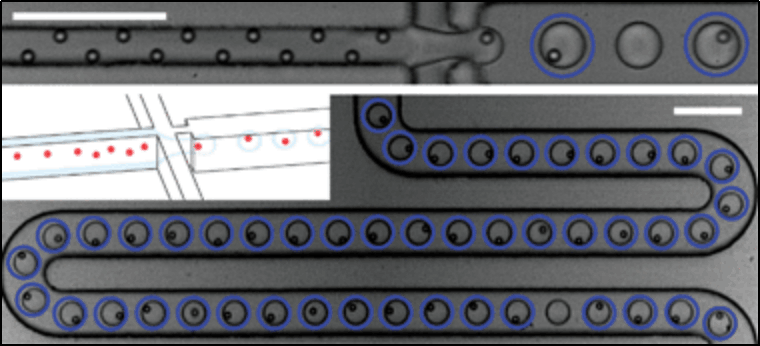
På trods af det store potentiale i disse applikationer, indkapslingen af mikrosfærer/celler er fuldstændig randomiseret, og begrænset af Poisson-fordelingen. Sandsynligheden for, at en dråbe indkapsler en enkelt mikrosfære er teoretisk set ikke mere end 37%, spild af et stort antal mikrosfærer og dråbepartitioner, hvilket resulterer i lav detektionsgennemstrømning. For at forbedre udnyttelsen af mikrosfærer eller sjældne celler, almindeligt anvendte metoder bruger typisk et teoretisk middel (λT) < 0.1 af mikrosfærer/celler pr. dråbe for at bestemme koncentrationen af påførte mikrosfærer, hvilket resulterer i en meget lav indkapslingshastighed af individuelle mikrosfærer, typisk nedenfor 10%. Nyd godt af det uendelige antal dråber i dråbesystemet, Poisson-fordelingen har mindre indflydelse på prøveforbrug og analysetid, når antallet af mikrosfærer/celler, der skal tælles, er lille.
Dråbeindkapsling af enkeltceller eller polystyrenmikrosfærer har en bred vifte af anvendelser inden for områder som digitale analyser, enkeltcelle sekventering, og lægemiddelscreening. Imidlertid, indkapslingen af mikrosfærer er fuldstændig randomiseret af Poisson-fordelingsbegrænsninger, og den teoretiske sandsynlighed for en-mikrosfære-indkapsling er normalt kun ca 10%. I ultrahøj-multiplekset digitaliseret detektion eller andre applikationer, der kræver måling af et stort antal mikrosfærer, antallet af partitioner, der skal tælles, er ekstremt højt, fører til en stor stigning i antallet af ugyldige dråbetællinger og redundans af detektionsdata. Af denne grund, Xiaoyu Yue designede en perleordret arrangementsdråbe (BOAD) system som en måde at bryde begrænsningerne for Poisson-fordelingen [1].
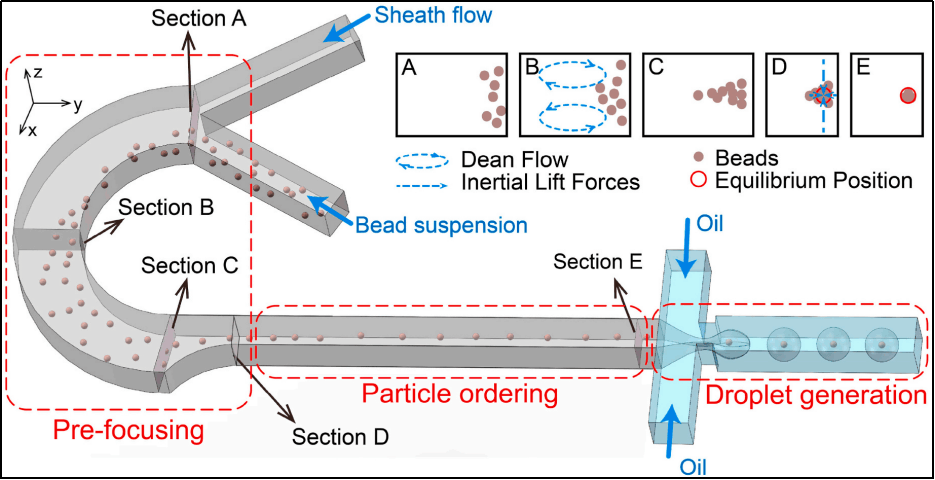
BOAD-systemet kombinerer hylsterflow på smart måde, Dean hvirvel, og kompressionsflowkanal for at realisere det første ordnede arrangement af mikrosfærer nogensinde og muliggør det hurtigste ordnede arrangement af mikrosfærer i den korteste struktur, med enkelt-perle-indkapslingseffektivitet op til ca 86%. Yderligere applikationer til at indkapsle kodede mikrosfærer og IL-10-målrettede magnetiske polystyren-mikrosfærer har fuldt ud demonstreret potentialet ved mikrosfære-baseret ultra-høj-multiplekset digital detektion. Som et resultat, BOAD-systemet er meget lovende til mange applikationer, der kræver høje enkeltpartikelindkapslingshastigheder i begrænsede rum, såsom ultra-høj-multipleksede digitale bioassays, enkeltcelleanalyse, lægemiddelscreening, og enkelt exosom detektion.
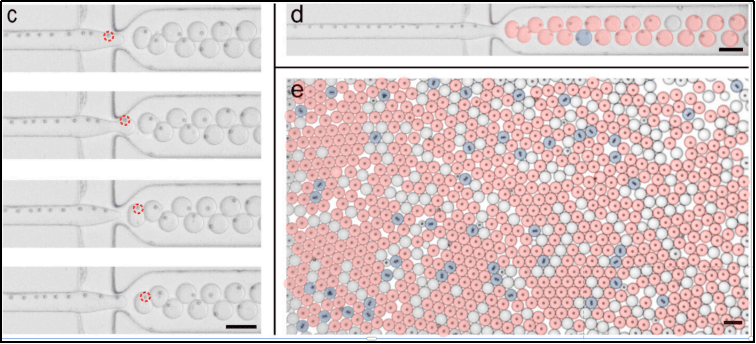
In all applications, droplet-based encapsulation of particles (cells and microspheres) is an ideal platform for single-cell analysis of cellular reprogramming, drug discovery, and secretion detection due to its uniformly small reactor diameters, unique microscale flow phenomena, and unlimited number of isolation units, and also allows for bead-based ultrasensitive digital detection of low-abundance proteins, exosomes, and other biomolecules.
Reference:
[1] Yue, X., Fang, X., Sun, T., Yi, J., Kuang, X., Guo, Q., Wang, Y., Gu, H. and Xu, H. 2022. Breaking through the Poisson Distribution: A compact high-efficiency droplet microfluidic system for single-bead encapsulation and digital immunoassay detection. Biosensors and Bioelectronics. 211, (Sep. 2022), 114384. DOI:https://doi.org/10.1016/j.bios.2022.114384.
[2] Zhou, Y., Ma, Z., Tayebi, M. and Ai, Y. 2019. Submicron Particle Focusing and Exosome Sorting by Wavy Microchannel Structures within Viscoelastic Fluids. Analytical Chemistry. 91, 7 (Apr. 2019), 4577–4584. DOI:https://doi.org/10.1021/acs.analchem.8b05749.
Leverandør
Shanghai Lingjun Biotechnology Co., Ltd.blev etableret i 2016 som er en professionel producent af biomagnetiske materialer og nukleinsyreekstraktionsreagenser.
Vi har stor erfaring med udvinding og oprensning af nukleinsyre, proteinoprensning, celleadskillelse, kemiluminescens, og andre tekniske områder.
Vores produkter er meget udbredt inden for mange områder, såsom medicinsk test, genetisk testning, universitetsforskning, genetisk avl, og så videre. Vi leverer ikke kun produkter, men kan også påtage os OEM, ODM, og andre behov. Hvis du har et relateret behov, er du velkommen til at kontakte os påsales01@lingjunbio.com.