Professionelle Hiersteller vu biomagnetesche Perlen


Uwendung vu Polystyrol-Mikrosphären an digitaler PCR
Als drëtt Generatioun vu PCR, digital PCR huet d'Virdeeler vun der absoluter Quantifizéierung, niddereg Prouf Noutwendegkeete, héich Empfindlechkeet, an Toleranz zu Inhibitoren, a gëtt wäit an der Detektioun vun der Genmutatioun benotzt, Kopie Zuel Variatioun, pathogene Mikroorganismen, a genetesch modifizéiert Kulturen. Den digitale PCR um Maart ass allgemeng Droplet Digital PCR (ddPCR) vertruede vun Bio-Rad an Chip Digital PCR (cdPCR) vertrueden vun Thermo Fisher; d.h., Bio-Rad deelt den Amplifikatiounssystem an Nano- oder Mikronenheeten duerch mikrofluid Technologie a Form vu Waasser-an-Ueleg, wärend Thermo Fisher den Verstärkungssystem an Nano- oder Mikron-Eenheeten duerch mikrofluidic Technologie trennt, an Thermo Fisher trennt d'Verstäerkungssystem an Nano- oder Mikron-Eenheeten duerch mikrofluidic Technologie. Mikrometer Eenheeten an Thermo Fisher trennt d'Verstäerkungssystem an Nano / Mikrometer Eenheeten duerch kierperlecht Ausschneiden. Dës zwee Technologieroute ginn am meeschte verbreet mat Bio-Rad Tropfen Mikrofluidiken, déi bedeitend Virdeeler vun der Miniaturiséierung bitt, Regionaliséierung, a Paralleliséierung wéinst senger Fäegkeet fir Mikrokugelen ze kapsuléieren, Zellen, an aner Reagenzen an Nanoliter oder Picoliter Mikroreaktoren.
Exosomen sinn sub-mikron Membranvesikelen (30-200 nm vun) vun Zellen secretéiert an enthält wichteg Informatioun wéi Proteinen, kleng RNA, an DNA, déi enk mat klineschen flëssege Biopsien fir Krankheetsdiagnostik a prognostesch Tester verbonne sinn. Allerdéngs, hir kleng Gréisst stellt eng grouss Erausfuerderung fir Exosomen aus komplexe Kierperflëssegkeeten mat héijem Duerchsatz a Rengheet ze isoléieren. Pinning Zhou et al. proposéiert eng ëmgedréint Wellekanalstruktur mat enger viskoelastescher Flëssegkeet mat der Zousatz vu biokompatibele Polymeren [2] fir elastesch Inertialfokuséierung a Sortéierung vun Submikronpartikelen an Exosomen. Déi repetitive Wellekanalstruktur produzéiert e periodesche Reverse Dean sekundäre Flux vu Mikrofluid, deen d'Mikrosphärefokusséierung am Verglach mat engem konventionelle riichtaus Kanal fördert. Mat véier verschiddene Gréisste vu fluoreszent Submikron Kugelen (1 µm, 500 nm vun, 300, an 100 nm vun) fir de Fokusverhalen ënner verschiddene Konditiounen ze studéieren, si erreecht einfach, héich Duerchmiesser, Label-gratis Zortéieren vun exosomes mat Rengheet méi héich wéi 92% an Erhuelung méi héich wéi 81%. Dës entwéckelt elastesch Inertial Exosom Sortéierungstechnik kann eng verspriechend Plattform fir verschidde exosom-relatéiert biologesch Studien a pharmazeutesch Uwendungen ubidden..
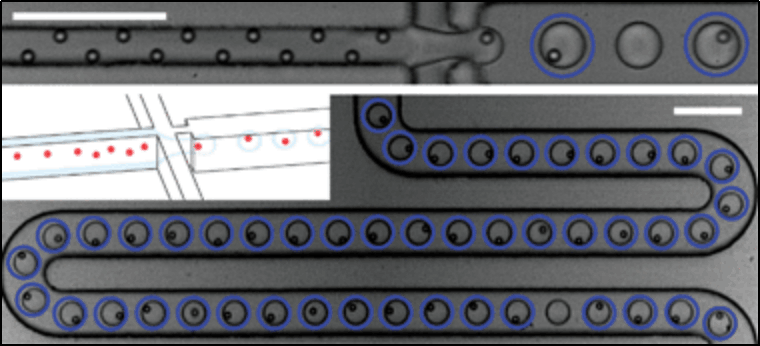
Trotz dem grousse Potenzial vun dësen Uwendungen, d'Verkapselung vu Mikrosphären / Zellen ass komplett randomiséiert, a limitéiert duerch d'Poisson Verdeelung. D'Wahrscheinlechkeet vun engem Tropfen, deen eng eenzeg Mikrokugel encapsuléiert ass theoretesch net méi wéi 37%, Verschwendung vun enger grousser Zuel vu Mikrosphären an Drëpspartitionen, wat zu engem nidderegen Detektiounsduerchgang resultéiert. Fir d'Notzung vu Mikrosphären oder rare Zellen ze verbesseren, allgemeng benotzt Methoden benotzen normalerweis en theoretesch Mëttel (λT) < 0.1 vu Mikrosphären / Zellen pro Tropf fir d'Konzentratioun vu Mikrokugelen ze bestëmmen déi applizéiert gëtt, wat zu enger ganz niddereger Verkapselungsquote vun eenzelne Mikrokugelen resultéiert, typesch drënner 10%. Profitéiert vun der onendlecher Unzuel vun Drëpsen am Drëpssystem, d'Poisson Verdeelung huet manner Impakt op Probeverbrauch an Assay Zäit wann d'Zuel vu Mikrosphären / Zellen déi gezielt ginn kleng ass.
Droplet Encapsulation vun eenzel Zellen oder Polystyrol Mikrosphären huet eng breet Palette vun Uwendungen a Beräicher wéi digital Assays, Single-Zell Sequenzéierung, an Drogenscreening. Allerdéngs, der Encapsulation vun microspheres ass komplett randomiséiert vun Poisson Verdeelung Contrainten, an d'theoretesch Wahrscheinlechkeet vun Single-Mikrosphär Encapsulation ass normalerweis nëmmen iwwer 10%. An ultra-héich-multiplexéiert digitaliséierter Detektioun oder aner Uwendungen déi d'Miessung vun enger grousser Unzuel vu Mikrosphären erfuerderen, d'Zuel vun de Partitionen déi musse gezielt ginn ass extrem héich, féiert zu enger grousser Erhéijung vun der Unzuel vun ongülteg Tropfenzuelen an Redundanz vun Detektiounsdaten. Aus dësem Grond, Xiaoyu Yue entworf e Bead Ordered Arrangement Droplet (BOAD) System als Wee fir d'Limitatiounen vun der Poisson Verdeelung ze briechen [1].
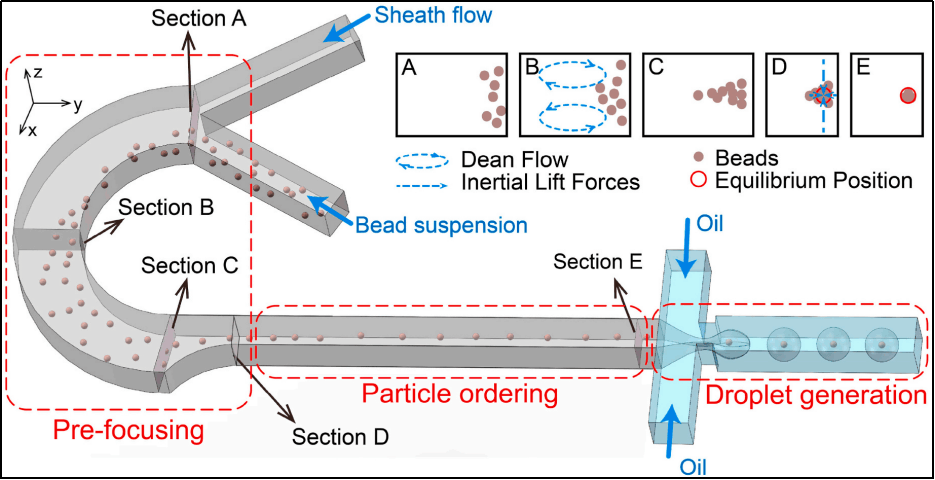
The BOAD system cleverly combines sheath flow, Dean vortex, and compression flow channel to realize the first-ever ordered arrangement of microspheres and enables the fastest ordered arrangement of microspheres in the shortest structure, with single-bead encapsulation efficiency up to about 86%. Further applications to encapsulate coded microspheres and IL-10-targeted magnetic polystyrene microspheres have fully demonstrated the potential of microsphere-based ultra-high-multiplexed digital detection. Als Resultat, the BOAD system is very promising for many applications that require high single-particle encapsulation rates within limited compartments, such as ultra-high-multiplexed digital bioassays, single-cell analysis, drug screening, and single exosome detection.
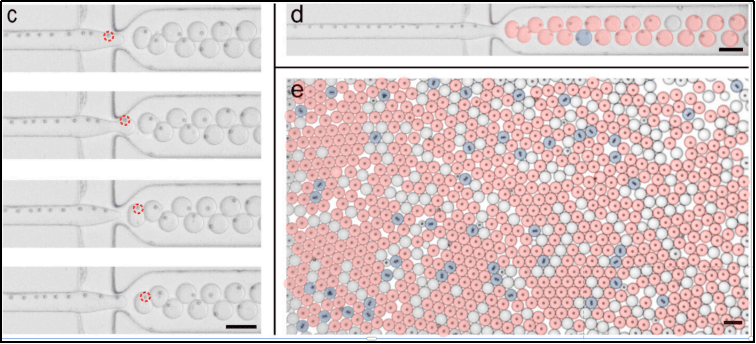
In all applications, droplet-based encapsulation of particles (cells and microspheres) is an ideal platform for single-cell analysis of cellular reprogramming, drug discovery, and secretion detection due to its uniformly small reactor diameters, unique microscale flow phenomena, and unlimited number of isolation units, and also allows for bead-based ultrasensitive digital detection of low-abundance proteins, exosomes, and other biomolecules.
Referenz:
[1] Yue, X., Fang, X., Sun, T., Yi, J., Kuang, X., Guo, Q., Wang, Y., Gu, H. and Xu, H. 2022. Breaking through the Poisson Distribution: A compact high-efficiency droplet microfluidic system for single-bead encapsulation and digital immunoassay detection. Biosensors and Bioelectronics. 211, (Sep. 2022), 114384. DOI:https://doi.org/10.1016/j.bios.2022.114384.
[2] Zhou, Y., Ma, Z., Tayebi, M. and Ai, Y. 2019. Submicron Particle Focusing and Exosome Sorting by Wavy Microchannel Structures within Viscoelastic Fluids. Analytical Chemistry. 91, 7 (Apr. 2019), 4577–4584. DOI:https://doi.org/10.1021/acs.analchem.8b05749.
Fournisseur
Shanghai Lingjun Biotechnology Co., Ltd., Ltd.gouf etabléiert an 2016 deen e professionnelle Hiersteller vu biomagnetesche Materialien an Nukleinsäure Extraktiounsreagenz ass.
Mir hu räich Erfahrung an Nukleinsäure Extraktioun an Offäll, Protein Reinigung, Zell Trennung, Chemilumineszenz, an aner technesch Beräicher.
Eis Produkter gi wäit a ville Beräicher benotzt, wéi medizinesch Tester, genetesch Tester, Universitéit Fuerschung, genetesch Zucht, an esou weider. Mir bidden net nëmmen Produkter, awer och kënnen OEM ënnerhuelen, ODM, an aner Besoinen. Wann Dir e verbonne Besoin hutt, weg fillen gratis eis ze kontaktéieren umsales01@lingjunbio.com.