Профессиональный производитель биомагнитных бусин


Исследования и достижения в области сортировки фрагментов ДНК
Твердофазная обратимая иммобилизация (СПРИ) В прошлом для выделения ДНК использовались методы 20 годы. В этом, суперпарамагнитные карбоксилированные магнитные шарики используются для селективного осаждения молекул ДНК разного размера в условиях полиэтиленгликоля. (ПЭГ) процент и концентрация соли, а полученные продукты можно использовать для подготовки библиотек образцов NGS.. Одним из ключевых моментов метода является определение критического значения ПЭГ, поскольку это важнейший параметр для селективного разделения фрагментов ДНК..
Более ранние исследования показали, что селективное выделение фрагментов ДНК связано с конформационным сдвигом морфологии ДНК от спирально-спиральной к глобулярной.. Ранее, Исследователи использовали различные методы для определения критической концентрации ПЭГ, которая вызывает переход молекул ДНК из спиральной в сферическую форму., такие как седиментация, флуоресцентная визуализация, вязкость, УФ/Вид центрифугирование, и динамическое рассеяние света (ДЛС), и круговой дихроизм. Однако, эти методы не применимы к растворам ДНК, содержащим магнитные шарики, поскольку глобулярные молекулы ДНК будут осаждаться на твердые поверхности.. Поэтому, более поздние исследователи использовали гель-электрофорез для определения критической концентрации ПЭГ для фрагментов ДНК определенного размера., однако, этот метод имеет ряд недостатков, такие как относительно длительное время электрофореза и менее точные результаты для критических значений..
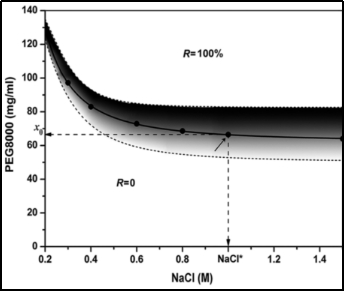
Поэтому, в 2013, Хэ Чжанъюн и др. [1] используется для изучения влияния различных концентраций полиэтиленгликоля (ПЭГ) по восстановлению фрагментов ДНК в присутствии 1 Карбоксилированные магнитные шарики мкм с фиксированной концентрацией хлорида натрия (NaCl). Они также сопоставили свои концентрации с концентрацией ПЭГ с помощью логистической функции и определили критическое значение ПЭГ с помощью подобранной логистической функции.. На этом основании, они получили функцию наклона уравнения восстановления путем вывода его производных первого порядка и использовали функцию наклона, основанную на этих параметрах, для построения спектра восстановления фрагмента ДНК, который позволил определить концентрацию NaCl и ПЭГ для разделения различных фрагментов. [2]. В дополнение к этому, в своем исследовании они обнаружили, что pH не влияет на эффективность их системы и что размер молекулярной массы ПЭГ обратно пропорционален размеру необходимой концентрации..
Тогда как ранее Э. Фрелих и др. [3] исследовали связывание ДНК с полиэтиленгликолями. (ПЭГ) разных размеров и композиций (например, ПЭГ 3350, ПЭГ 6000, и MPEG-антрацен) в соляно-ионных растворах. Структурный анализ показал, что ПЭГ 3350 и ПЭГ 6000 образует умеренные комплексы, тогда как аддукты мПЭГ-антрацен-ДНК слабо взаимодействовали с гидрофильными и гидрофобными группами, находящимися в контакте.. Стабильность образовавшихся комплексов была порядка ПЭГ. 6000 > ПЭГ 3350 > мПЭГ-антрацен, почти одна молекула ПЭГ связана с ДНК. Никаких конформационных изменений для B-ДНК не наблюдалось., тогда как при более высоких концентрациях ПЭГ ДНК конденсировалась и образовывала частицы.
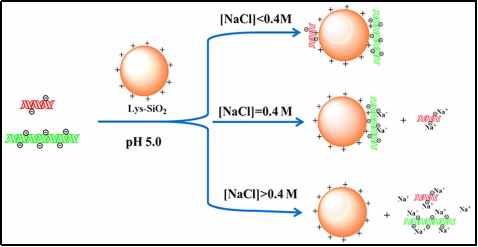
Кроме того, Линлин Лю и др.[2] продемонстрировали, что частицы лизинового кремнезема можно использовать для разделения по размеру бинарных и тройных смесей ДНК путем регулирования электростатических взаимодействий между фрагментами ДНК и поверхностью частиц кремнезема, функционализированного лизином, в зависимости от pH окружающей среды., в частности, ионная сила. Заряд фрагментов ДНК, и электростатические взаимодействия между ними и поверхностью противоположно заряженных частиц кремнезема, определялось pH среды. Заряд фрагментов ДНК и их электростатические взаимодействия с поверхностью противоположно заряженных частиц кремнезема тесно связаны с размером фрагментов ДНК., а механизм селективного разделения фрагментов ДНК с помощью частиц Lys-SiO2 показан на рисунке. 1.
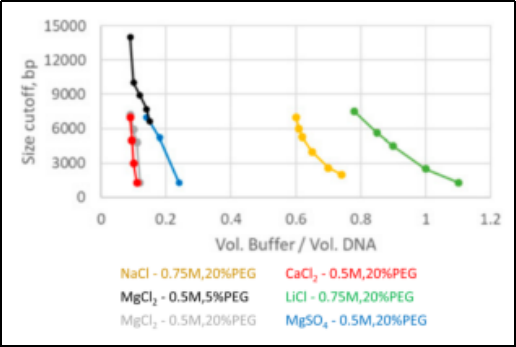
В 2020 Алексей и др. [4] сдвинут интервал селективного выделения фрагментов ДНК 150-800 б.п. до 1.5-7 Kbp путем регулирования концентрации NaCl в буфере с магнитными шариками.. При замене NaCl другими катионами и снижении концентрации полиэтиленгликоля (ПЭГ) 8000, интервалы выборочно разделенных фрагментов ДНК варьировались, причем LiCl здесь наиболее эффективен.
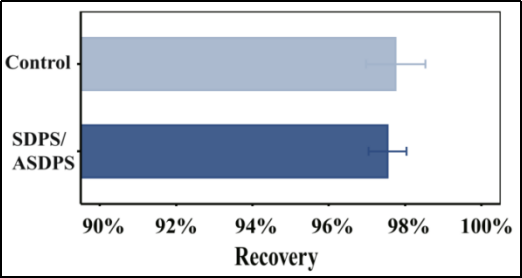
2023 Данли и др. [5] протестировали максимальное восстановление критических концентраций полиэтиленгликоля (ПЭГ) 8000 и 300 нм-карбоксилированные магнитные шарики, определение композиции буфера магнитных шариков для карбоксилированных магнитных шариков 20% ПЭГ 8000, 2М NaCl, и 16.3 мМ MgCl2, вместе с 1.25 магнитные шарики мг/мл. Затем они протестировали протокол восстановления ДНК, сравнимый с контрольным протоколом Бекмана. (Магнитные шарики AMPure XP).
Резервные буферы не универсальны из-за разных параметров магнитных бусин разных типов.. Однако, любой исследователь может дополнительно оптимизировать суспензионный буфер магнитных шариков на основе известных результатов данных для эффективного восстановления или для различных экспериментальных целей.. От стандартных коммерческих методов очистки ДНК до корректировки концентрации гранул SPRI и оптимальных буферов для суспензии гранул., это может предоставить исследователям большую гибкость и удобство для различных условий манипуляций с ДНК.. Кроме того, различные стратегии очистки ДНК имеют большой потенциал для применения в биологической и медицинской областях..
Ссылка:
[1] ОН З, ZHU Y, ДО Ч. Новый метод определения критической концентрации полиэтиленгликоля для селективного осаждения фрагментов ДНК[J/OL]. Прикладная микробиология и биотехнология, 2013, 97(20): 9175-9183. DOI:10.1007/s00253-013-5195-0.
[2] ОН З, Сюй Х, СЮН М, и др.. Разделение ДНК по размеру: Спектры восстановления помогают определить хлорид натрия. (NaCl) и полиэтиленгликоль (ПЭГ) необходимые концентрации[J/OL]. Биотехнологический журнал, 2014, 9(10): 1241-1249. DOI:10.1002/биот.201400234.
[3] ПЭГ и мПЭГ-антрацен индуцируют конденсацию ДНК и образование частиц | Журнал физической химии B[ЭБ/ПР]. https://pubs.acs.org/doi/10.1021/jp205079u.
[4] СТОРЧЕВОЙ А., КАМЕЛА Н, ЛЕВИН С С. Выбор размера SPRI Beads в диапазоне 2-10 КБ[J/OL]. Журнал биомолекулярных методов : ДБТ, 2020, 31(1): 7-10. DOI:10.7171/и т. д. 20-3101-002.
[5] ЛЮ Д, ЖИДКОСТЬ, ЛУО Дж., и др.. Стратегия очистки ДНК на основе гранул SPRI, обеспечивающая гибкость и экономическую эффективность[J/OL]. БМК Геномика, 2023, 24(1): 125. DOI:10.1186/s12864-023-09211-w.
Поставщик
Шанхайская биотехнологическая компания Линцзюнь., ОООбыл создан в 2016 который является профессиональным производителем биомагнитных материалов и реагентов для экстракции нуклеиновых кислот..
Мы имеем богатый опыт в экстракции и очистке нуклеиновых кислот., очистка белка, разделение клеток, хемилюминесценция, и другие технические области.
Наша продукция широко используется во многих областях., например, медицинское тестирование, генетическое тестирование, университетские исследования, генетическое разведение, и так далее. Мы не только поставляем продукцию, но и можем взять на себя OEM, ОДМ, и другие потребности. Если у вас есть соответствующая потребность, пожалуйста, не стесняйтесь обращаться к нам по адресуsales01@lingjunbio.com.