Professional Manufacturer of Biomagnetic Beads


How can the inhibitory effect of magnetic beads on PCR be mitigated?
With the advancement of
precision medicine and the reduction in NGS sequencing costs,magnetic bead-based nucleic acid extraction has become standard practice in molecular diagnostics laboratories. To achieve higher recovery rates and avoid errors caused by incomplete elution, an increasing number of researchers opt to add magnetic beads capturing nucleic acids directly into the PCR system for amplification.
However
While this “PCR with Magnetic beads” approach streamlines workflows, it has introduced insidious frustrations for many practitioners: PCR amplification failures, elevated Ct values, or even absent amplification curves. The culprit behind these issues is often the magnetic beads themselves, which inhibit the PCR system.
Many intuitively assume magnetic beads are merely inert solid carriers that should not interfere with amplification. Yet experimental data consistently demonstrates widespread bead-induced PCR inhibition.
Preliminary experiments employing our magnetic bead products 160011, 160013, and 220015 for bead-in-PCR revealed:
| No. | 1 | 2 | 3 | 4 | 5 | 6 | 7 | 8 | 9 |
| MB | 160011(50mg/ml) | 160013(50mg/ml) | 220015(50mg/ml) | ||||||
| Content | 0.5mg | 0.75mg | 1mg | 0.5mg | 0.75mg | 1mg | 0.5mg | 0.75mg | 1mg |
Result as follow:
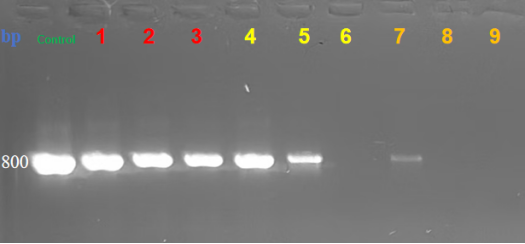
Based on electrophoresis results, amplification efficiency at a magnetic bead concentration of 0.5 mg: 220015 < 160013 < 160011; Given the known magnetic bead particle sizes: 220015 < 160013 < 160011, and considering their specific surface areas: 160011 < 160013 < 220015, the binding sites per bead under identical conditions are thus: 160011<160013<220015; This may explain why PCR inhibition becomes more pronounced as magnetic bead concentration increases.
Consequently
A special component—an enhancer—is required in this PCR system. Common enhancers include betaine, trehalose, DMSO (dimethyl sulfoxide), glycerol, and BSA (bovine serum albumin). Among these, BSA acts as a sacrificial substrate, preferentially binding to magnetic beads to shield the polymerase from inhibitor interference.
So we sought to determine whether reducing magnetic bead concentration (0.025 mg–0.075 mg) supplemented with 100 μg/ml BSA as a PCR enhancer would yield more favourable results.
| No. | 1 | 2 | 3 | 4 | 5 | 6 | 7 | 8 | 9 |
| MB | 160011(50mg/ml) | 160013(50mg/ml) | 220015(10mg/ml) | ||||||
| Content | 0.025mg | 0.05mg | 0.075mg | 0.025mg | 0.05mg | 0.075mg | 0.005mg | 0.01mg | 0.015mg |
Result as follow:
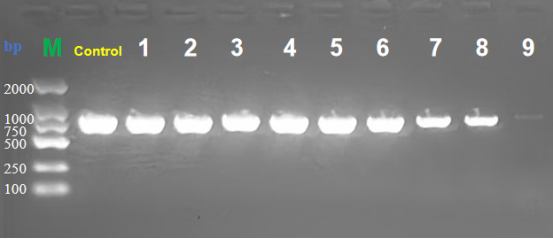
It can be observed that at 0.025 mg, 160011 and 160013 exhibit no difference from the control, whereas at 0.05 mg and 0.075 ng, their efficacy diminishes progressively. 220015, consistent with previous analyses, not only exhibits excellent suspension properties but also possesses a large specific surface area with numerous binding sites. This enables effective adsorption of Taq polymerase, thereby inhibiting amplification. When the magnetic bead concentration was reduced to 0.005 mg, the band intensity reached only half that of the control.
Following the foundational optimisation under these conditions, our 220013 product shall be selected for efficacy validation.:
| No. | 1 | 2 | 3 | 4 | 5 | 6 | 7 | 8 |
| MB | 220013(10mg/ml) | 220015(10mg/ml) | ||||||
| Content | 0.003mg | 0.005mg | 0.007mg | 0.01mg | 0.003mg | 0.005mg | 0.007mg | 0.01mg |
Result as follow:
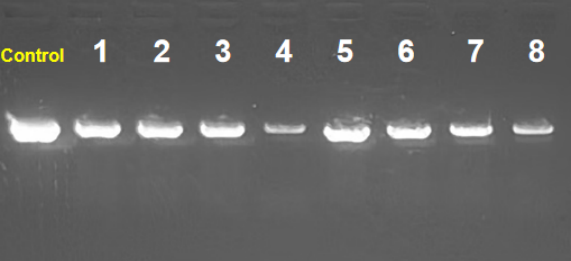
It can be observed that the performance outcomes of 220013 and 22015 are indistinguishable.
The aforementioned magnetic beads 160011, 160013, 220013, and 220015 can all achieve optimal results in PCR through system optimisation. They are suitable for application in POCT rapid testing, pathogenic microorganism detection, automated extraction, and similar scenarios.
Supplier
Shanghai Lingjun Biotechnology Co., Ltd. was established in 2016 which is a professional manufacturer of biomagnetic materials and nucleic acid extraction reagents.
We have rich experience in nucleic acid extraction and purification, protein purification, cell separation, chemiluminescence, and other technical fields.
Our products are widely used in many fields, such as medical testing, genetic testing, university research, genetic breeding, and so on. We not only provide products but also can undertake OEM, ODM, and other needs. If you have a related need, please feel free to contact us .