Fabricante profesional de perlas biomagnéticas


Estrategias básicas y aplicación para la clasificación de fragmentos de ADN.
El principio de purificación de ácidos nucleicos con perlas magnéticas se basa en la tecnología de inmovilización reversible en fase sólida (SPRI), cuyo mecanismo de acción aún no está muy claro. La teoría del puente salino es actualmente una explicación más científica, eso es, en concentraciones más altas de alcohol y solución salina, capturan el agua de la capa de hidratación fuera de las moléculas de ADN., resultando en la agregación de moléculas de ADN y precipitación, para que los grupos fosfato cargados negativamente queden expuestos. Los iones de sal forman un "puente de sal", También llamado “puente eléctrico”., con los grupos en la superficie de las cuentas, haciendo que el ADN sea adsorbido en la superficie de las perlas.
La precipitación con isopropanol y etanol es demasiado poderosa., por lo que la clasificación de fragmentos generalmente no se utiliza, pero polímeros no iónicos solubles en agua PEG, eso es, polietilenglicol como precipitante, y debido al PEG viscoso, las perlas magnéticas en el tampón pueden obtener una buena suspensión. En el proceso de unión al ADN., Las perlas magnéticas pueden tener un contacto más completo con el ADN., y el PEG no es fácil de causar desnaturalización de proteínas y adsorción no específica. Sin embargo, El efecto de deposición de ADN del PEG se ve fácilmente afectado por el pH y la temperatura., y el PEG no es fácilmente soluble en agua cuando la temperatura es demasiado baja, entonces las cuentas magnéticas Generalmente se requiere que se equilibren a temperatura ambiente antes de su uso., y algunos estabilizadores de bajo pH, como Tris-HCl, etc., se agregará al buffer de cuentas magnéticas.
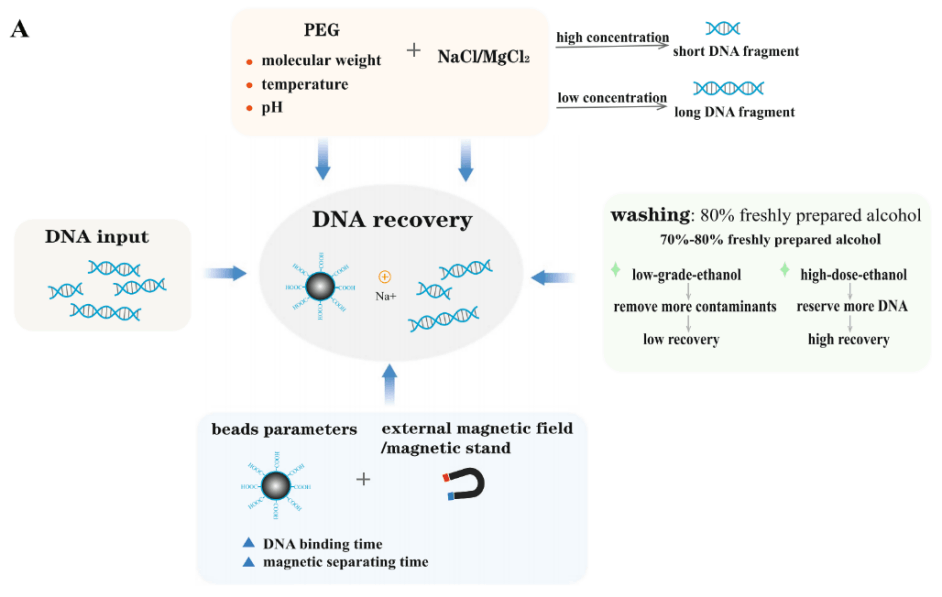
Cuanto más largo sea el ADN, Cuanto más grupos fosfato cargados negativamente están expuestos en la superficie, cuanto más fuerte es la carga negativa de toda la molécula, más fácil será ser absorbido por las perlas magnéticas, y sólo se necesita una menor concentración de PEG y NaCl para recuperarlo; cuanto más corto es el ADN, cuanto mayor sea la concentración de PEG y NaCl, se necesitará más para destruir la capa de hidratación de la superficie, y exponer suficientes grupos fosfato cargados negativamente para ser adsorbidos por las perlas magnéticas., y así recuperado. y así se recuperó. Entonces, si desea recuperar fragmentos de ADN más cortos, necesitas agregar un volumen mayor de cuentas magnéticas (como se muestra en la figura 1).
Por lo tanto, El procedimiento general de clasificación de fragmentos es adsorber fragmentos grandes con tampón de perlas diluido en la primera ronda., y luego agregue tampón de perlas para adsorber los fragmentos especificados en la segunda ronda después de tomar el sobrenadante, para obtener el ADN fragmentado deseado. Actualmente, la mayoría de los esquemas de clasificación de fragmentos en el mercado utilizan perlas carboxiladas en combinación con diferentes concentraciones de iones de sal y porcentajes de PEG para recuperar fragmentos de diferentes longitudes., pero por supuesto, hay otro esquema, cual es El método del apóstol de la primera adsorción de fragmentos grandes con perlas magnéticas carboxiladas (El sustrato A se muestra en la figura.. 2) a una cierta concentración de iones de sal y PEG, y luego adsorber pequeños fragmentos con perlas magnéticas de sílice hidroxiladas (El sustrato B se muestra en la figura.. 2) a una cierta concentración de iones de sal y PEG [2].
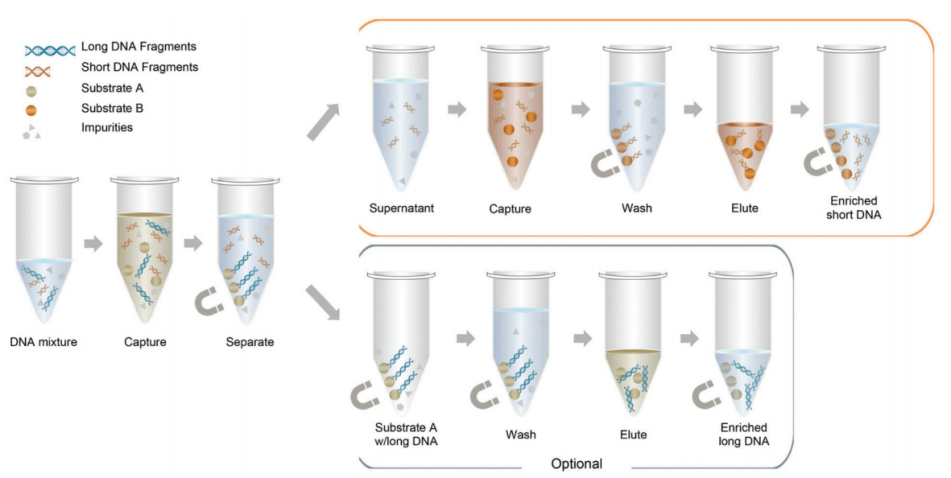
El método de perlas magnéticas para la clasificación de fragmentos es una solución eficaz., rápido, y una técnica muy específica, y la clasificación de fragmentos es uno de los pasos clave en el proceso de preparación de la biblioteca NGS. Mediante clasificación de fragmentos, puede garantizar que el tamaño de los fragmentos de ADN en la biblioteca cumpla con los requisitos de la plataforma de secuenciación, mejorando así la calidad de los datos de secuenciación y la precisión del análisis. En el campo del diagnóstico molecular., La tecnología de clasificación de fragmentos se utiliza para mejorar la sensibilidad y especificidad de la detección.. Las perlas magnéticas de clasificación de fragmentos también se pueden utilizar para la purificación de productos de PCR para experimentos posteriores..
Referencias:
[1] LIU D, LIQ, LUO J., etc.. Una estrategia de purificación de ADN basada en perlas SPRI para mayor flexibilidad y rentabilidad[J/OL]. Genómica BMC, 2023, 24(1): 125. DOI:10.1186/s12864-023-09211-w.
[2] ZHANG B, ZHAO S, WAN H, etc.. Enriquecimiento del tamaño del ADN de alta resolución mediante una nanoplataforma magnética y aplicación en pruebas prenatales no invasivas[J/OL]. El analista, 2020, 145(17): 5733-5739. DOI:10.1039/D0AN00813C.
Proveedor
Shanghai Lingjun Biotecnología Co., Limitado.se estableció en 2016 que es un fabricante profesional de materiales biomagnéticos y reactivos de extracción de ácidos nucleicos..
Tenemos una rica experiencia en extracción y purificación de ácidos nucleicos., purificación de proteínas, separación celular, quimioluminiscencia, y otros campos técnicos.
Nuestros productos son ampliamente utilizados en muchos campos., como pruebas médicas, pruebas genéticas, investigación universitaria, mejoramiento genético, etcétera. No solo proporcionamos productos sino que también podemos realizar OEM, ODM, y otras necesidades. Si tienes una necesidad relacionada, no dude en contactarnos enventas01@lingjunbio.com.